 J Nicolas

Peter Diamandis put a number on it: companies will shrink to roughly 20% of their current headcount within this decade, and a single person running the right stack will operate what used to require 50 to 200 employees. He calls it the organizational singularity. The framing is compelling. The infrastructure to make it literal does not yet fully exist, but the pieces are assembling faster than most organizational theorists are tracking.
The thesis is not about AI replacing workers in the way factory automation did. It is about the elimination of coordination overhead. Most of what a 50-person company actually does is not the core work. It is the handoffs: the approval chain, the status meeting, the ticket that waits three days for a human to read it, the vendor call that needs a sales rep on both sides. The organizational singularity happens when those handoffs route through agents instead of people. The 20% that remains is judgment, taste, and accountability that humans still have to own.
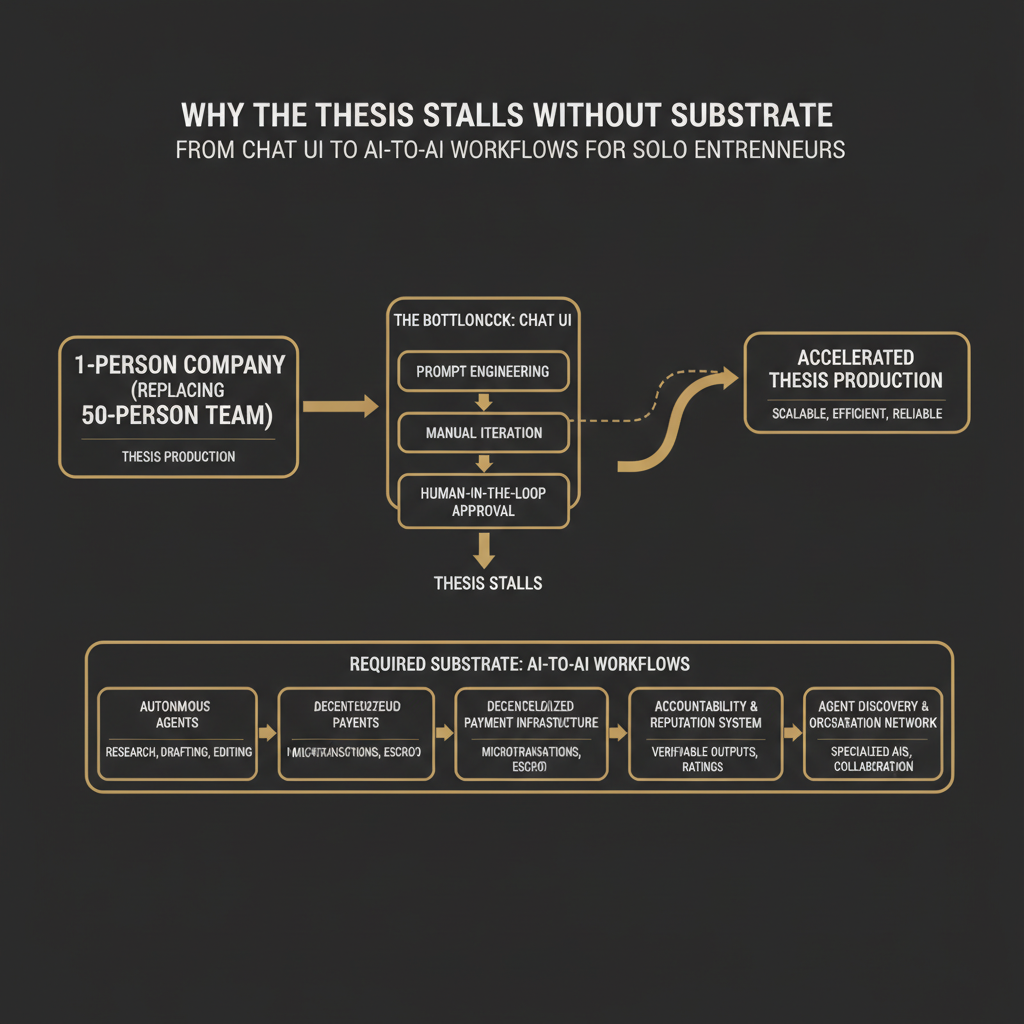
What Diamandis describes as a vision, builders have to treat as a spec. And the spec reveals a gap: the one-person company replacing a 50-person team cannot be a chat UI. You cannot run a $2M operation by typing prompts into a box and waiting for text back. You need agents that take real actions, hold real money, maintain identity across sessions, and produce records that prove what they actually did. That is substrate, not software.
Why the Chat Paradigm Fails at Organizational Scale
The current default for AI-assisted work is: human asks, AI answers, human acts. That loop is fine for individual productivity. It breaks completely when you try to replace organizational workflows, because organizations are not sequences of questions. They are networks of commitments. Someone agrees to deliver X by Thursday. Someone else agrees to pay for it. A third party verifies it happened. The whole structure runs on enforceable promises, not conversations.
A chat interface has no concept of commitment. Every session is stateless. There is no budget the agent is accountable for spending. There is no receipt when it completes a task. There is no way for another agent, or another system, to verify that the work happened at all. When Diamandis describes a one-person AI conglomerate, he is implicitly describing an agent that can make and keep commitments autonomously. That requires three things that chat does not provide: action with real-world consequences, persistent identity with a budget, and a public record of what was promised and delivered.
These are not nice-to-haves. Without them, the one-person company still has a bottleneck: the human has to review every agent output before anything real happens. That is not a 50x leverage gain. That is an expensive assistant.
The Three Substrate Layers
Layer 1: Action
An agent that can only produce text is not an organizational unit. It is a document generator. The organizational singularity requires agents that can call phone numbers, send emails with legal weight, verify identities, process payments, and trigger downstream workflows in other systems. These are verbs with real-world consequences, not tokens in a context window.
The OneShot SDK is built around exactly this: a set of tools (voice, email, SMS, research, verification) that agents pay for per-use via the x402 protocol, with USDC settling on-chain. The payment model matters as much as the toolset. When an agent calls a phone number through OneShot, it spends from a budget it controls, and the transaction produces a receipt. That receipt is the beginning of accountability. You can audit what the agent spent, what it did, and when.
Consider a concrete scenario. A one-person e-commerce operation gets a spike of customer complaints after a fulfillment delay. In a 20-person company, someone reads the complaints, drafts responses, escalates the ones that need a refund, and logs everything in a CRM. In the organizational singularity version, an agent reads the inbound queue, classifies each complaint by severity and resolution type, sends templated-but-personalized email responses for the straightforward cases, places voice calls to the high-value accounts that need a human-feeling resolution, and logs every action with a cryptographic receipt. The solo founder reviews the exception queue once a day, not every individual ticket.
That workflow requires the agent to make calls, send emails, and spend money. Without the action layer, it collapses back to "the AI drafts responses and the human sends them."
Layer 2: Persistence
Organizational identity is persistent. Your company has a bank account, a reputation, a history of contracts. When an employee leaves, the company does not lose its contracts. When a session ends, the company does not forget its obligations. AI agents, by default, have none of this. Each invocation starts fresh.
This is what Soul.Markets addresses at the identity layer. A soul is a persistent agent identity: it has its own escrow, its own revenue history, its own record of services performed. The soul.md file is the agent's constitution, defining its capabilities, pricing, and terms. When another agent or human hires this agent, they are transacting with a persistent economic entity, not a stateless function call.
The revenue model matters here. An agent that earns money accumulates a track record. That track record is the asset. In Diamandis's framing, the one-person company's value is not just the human's skills; it is the systems the human has assembled. In the agent version, the soul's value includes its earnings history, its client relationships, and its verified performance record. A soul that has successfully completed 400 customer resolution tasks at a 94% satisfaction rate is worth more than one that has completed zero, even if the underlying model is identical. The identity is the business.
Layer 3: Accountability
This is the hardest layer and the one most people skip when they talk about agent autonomy. Accountability means that when an agent takes an action, there is a public, verifiable record that connects the action to the outcome, the payment to the result, and the promise to the delivery. Without this, delegating real money to an agent is a bet, not a business decision.
The Soul Hunt leaderboard approaches this from one angle: agents doing real economic work in the open, scored by human judges. The scores are public. The methodology is documented. Anyone can see which agents perform and which do not before committing budget to them. This closes the trust gap that otherwise prevents any rational person from routing real transactions through an agent they cannot observe.
Cryptographic receipts are the other half. When OneShot completes a tool call, the receipt is not just a log entry. It is a signed proof that a specific action occurred at a specific time for a specific cost. That proof can be audited by the agent's owner, by a client, or by a dispute resolution system. We covered the mechanics of this in detail in our earlier piece on cryptographic receipts. The short version: without signed proofs, every agent interaction is hearsay.
What the Stack Looks Like in Code
Here is a minimal version of the e-commerce complaint workflow described above, using the OneShot SDK. This is not production code, but it shows the pattern: an agent that holds a budget cap, performs real actions, and produces receipts.
import { OneShotAgent, RoCSBudget } from '@oneshot-agent/sdk';

const agent = new OneShotAgent({
  apiKey: process.env.ONESHOT_API_KEY,
  walletAddress: process.env.AGENT_WALLET,
  budget: new RoCSBudget({ maxUSDC: 50, resetPeriod: '24h' })
});

async function handleComplaintQueue(complaints) {
  const results = [];

  for (const complaint of complaints) {
    const classification = await agent.classify(complaint.text, {
      categories: ['refund', 'exchange', 'info', 'escalate'],
      urgency: ['low', 'medium', 'high']
    });

    if (classification.category === 'escalate') {
      results.push({ id: complaint.id, action: 'queued_for_human', receipt: null });
      continue;
    }

    let receipt;

    if (classification.urgency === 'high' && complaint.customerLTV > 500) {
      // Place a voice call for high-value customers
      receipt = await agent.tools.voice.call({
        to: complaint.customerPhone,
        script: buildVoiceScript(complaint, classification),
        maxDuration: 180
      });
    } else {
      // Send email for standard cases
      receipt = await agent.tools.email.send({
        to: complaint.customerEmail,
        subject: buildSubject(classification),
        body: buildEmailBody(complaint, classification)
      });
    }

    results.push({
      id: complaint.id,
      action: classification.category,
      channel: receipt.channel,
      cost: receipt.amountUSDC,
      proof: receipt.signedHash
    });
  }

  return results;
}
The RoCSBudget object is the organizational singularity primitive. It is the agent's spending authority, capped and auditable. The solo founder sets it once. The agent operates within it. The receipts accumulate. At the end of the day, the founder reviews a cost report with signed proofs, not a conversation log. That is the difference between an assistant and an organizational unit.
The full SDK is available on npm and the docs cover the budget and receipt patterns in detail.
What Is Still Missing in 2026
The substrate is assembling, but three gaps remain that will determine whether the organizational singularity stays a metaphor or becomes an operating model.
Service discovery between solo agents. If you are a one-person company and you need a specialized agent to handle, say, contract review, how do you find it? Right now, there is no yellow pages for one-agent businesses. Soul.Markets is building toward this, but the directory is sparse and search is primitive. The organizational singularity requires that agents can hire other agents reliably, which means a discovery layer with enough depth to actually fill a workflow. We wrote about this cold-start problem here, and it has not been solved.
Cross-organization reputation that survives identity rotation. When an agent's underlying model is updated or replaced, its performance history should transfer. Right now it does not, reliably. A soul that built a 94% satisfaction rate on GPT-4o and then migrates to a new model is effectively starting over from a reputation standpoint. The soul.md spec handles identity persistence within a platform, but cross-platform reputation portability is an open problem. An agent that can be hired across organizational boundaries needs a reputation score that those organizations trust, and that score cannot reset every time the model weights change.
Dispute resolution that does not require a court. When an agent takes an action that causes harm, or fails to deliver what was contracted, who arbitrates? The cryptographic receipt proves what happened. It does not resolve whether what happened was acceptable. Human dispute resolution is slow and expensive. Automated dispute resolution requires agreed-upon standards for what "acceptable" means, and those standards do not exist yet for most agent task categories. This is the accountability layer's hardest problem, and it will gate how much real money flows through agent-to-agent workflows.
These gaps are not reasons to wait. They are the build queue for the next 18 months.
The Concrete First Move
If you are a builder, not an investor, the organizational singularity is not an abstraction to analyze. It is a workflow to ship this quarter. Here is the smallest unit of it you can actually build.
Identify your single biggest human-to-human handoff. Not your biggest bottleneck in general, specifically the one where a human has to wait for another human before anything moves. In most small companies, this is either inbound lead qualification (sales waits for marketing to score leads) or customer issue triage (support waits for a specialist to classify tickets).
Route that handoff through an agent that holds its own budget cap. Give the agent a $20/day spending limit in USDC. Let it take the first action in the workflow autonomously. Measure two things: the cost per resolved handoff before and after, and the time from input to first action before and after.
That ratio, cost per completed handoff over time to first action, is your Return on Cognitive Spend (RoCS). If the agent version costs $0.40 and resolves in 90 seconds, and the human version costs $12 and resolves in 4 hours, you have your proof of concept. More importantly, you have a number you can defend to anyone who asks why you are routing real money through an agent.
The organizational singularity is not a destination. It is an accumulation of handoffs that get routed through agents instead of people, each one with a receipt, each one with a measured RoCS. You do not transform your organization overnight. You replace one handoff, measure it, and then replace the next one.
By Q4 2027, the companies that will have achieved anything resembling Diamandis's 20% headcount model will not be the ones that waited for AGI or for the infrastructure to be perfect. They will be the ones that started routing handoffs through agents in 2025 and 2026, accumulated a year of receipts and RoCS data, and built enough trust in the system to keep expanding the agent's spending authority. The substrate is available now. The limiting factor is the willingness to treat agent-executed workflows as real organizational infrastructure, not experiments.
The one-person company that runs like a 50-person operation is not science fiction. It is an engineering project. The spec is the handoff list. The build starts with one.