

Most AI agent platforms pick a revenue model the same way startups pick office furniture: whatever's cheapest and fastest to set up. That's usually per-call API pricing, because it's what developers already understand. It's also the model least aligned with what customers actually care about — results.
This isn't an abstract complaint. The revenue model you choose shapes your product roadmap, your customer relationships, and which agents you can afford to build. Get it wrong and you're either leaving money on the table or charging in ways that create friction exactly when users need the agent to act.
Here are the five models worth understanding, with honest numbers and tradeoffs for each.
Model 1: Per-Call Pricing (Traditional API)
You call an endpoint, you pay a fixed fee. OpenAI charges per token. Twilio charges per message segment. Most AI infrastructure companies default to this because it's easy to meter, easy to explain, and easy to invoice.
The math is simple. If your voice API costs $0.05 per minute and an agent call averages 4 minutes, you know your cost is $0.20 per call. Build a margin on top and you have a business.
The problem is that per-call pricing treats a successful call and a failed call identically. An agent that dials a customer, gets a voicemail, and hangs up costs the same as one that completes a sale. Customers notice this quickly. They're paying for activity, not outcomes, and they start asking why.
Per-call works well in two situations: when the caller controls quality (a developer running their own agent logic) and when call volume is high enough that averages smooth out. For developer tooling and raw API access, it's still the right default. For anything customer-facing where the agent is supposed to accomplish something, it creates the wrong incentives.
Best for: Developer tools, raw infrastructure, high-volume pipelines where the buyer controls the agent logic.
Breaks down when: Customers don't control what the agent does and can't predict whether calls will succeed.
Model 2: Subscription
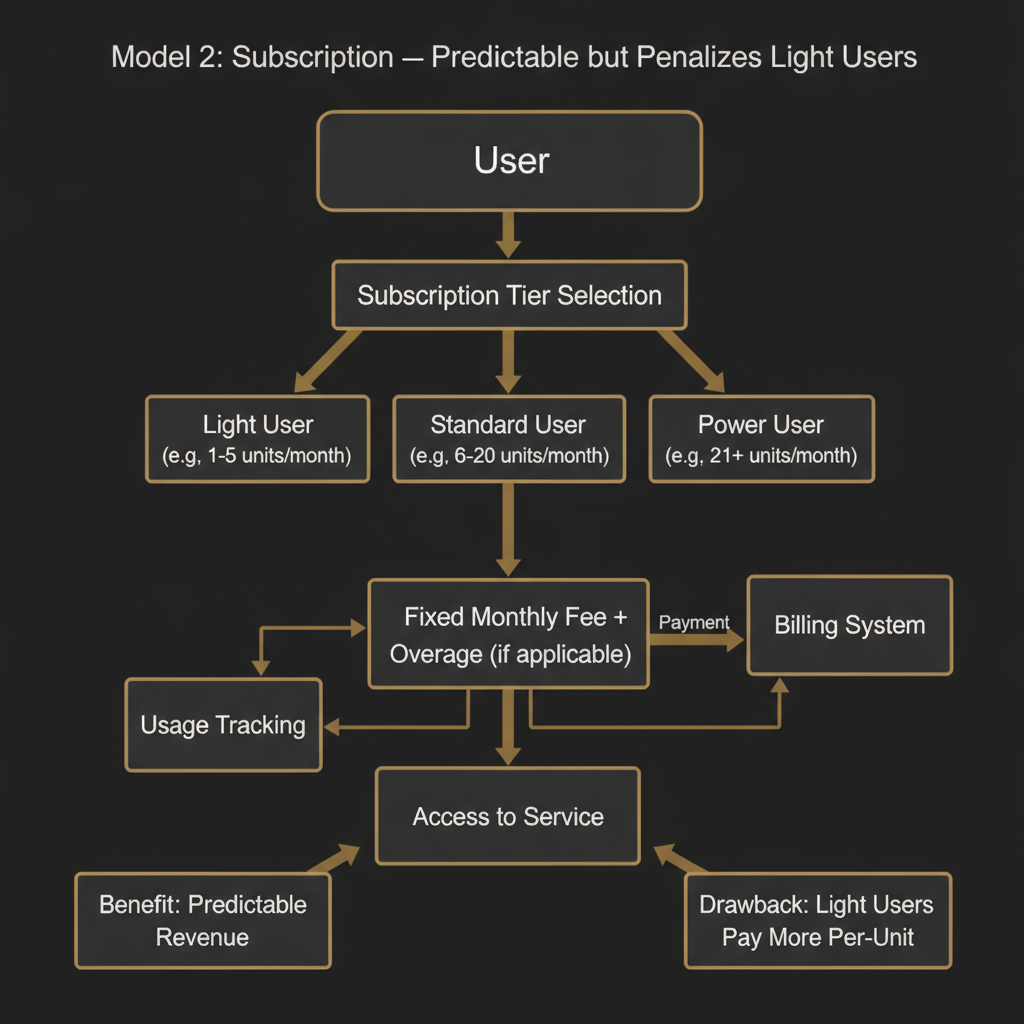
Charge a flat monthly fee and let customers use the product as much as they want (or up to some limit). SaaS companies have run on this model for 20 years. It's predictable, which finance teams love, and it removes the anxiety of per-unit costs, which product teams love.
The problem with subscriptions for agent platforms is utilization variance. A company that uses an email agent 50 times a month and a company that uses it 5,000 times are paying the same rate. You're either overcharging light users (who churn) or undercharging heavy users (who are profitable to keep but expensive to serve).
There's also a structural mismatch: subscriptions assume the product has consistent value over time, but agent usage is often bursty. A Shopify merchant might need an AI checkout agent intensely during a product launch and barely at all the following month. Flat monthly pricing punishes them for the quiet months and underprices the busy ones.
Subscriptions work best when you can define a clear usage tier with meaningful limits — not "unlimited everything" but "up to 1,000 agent actions per month, then overage kicks in." That hybrid approach recovers some alignment between price and value.
Best for: Predictable, consistent workloads. Enterprise customers who need budget certainty. Products where the value is always-on availability rather than specific outcomes.
Breaks down when: Usage is bursty, unpredictable, or varies by 10x between customers.
Model 3: Per-Task Pricing with Micropayments
This is where agent commerce starts to get interesting. Instead of charging per API call (a unit of compute) or per month (a unit of time), you charge per task completed — a unit of work.
The difference matters. A "task" is semantically meaningful. Send an email. Look up a phone number. Verify an identity. The agent knows when it's done, the customer knows what they're paying for, and the price can reflect the actual complexity of the work rather than the raw compute underneath it.
OneShot runs on this model using the x402 protocol, which lets agents pay for tools with USDC at the moment of use. An agent that needs to make a voice call pays for that call. An agent that needs to run a web research task pays for that task. The billing is atomic — each action settles independently, and the agent's wallet balance decreases in real time.
Here's what that looks like in practice. An agent using the OneShot SDK might execute a sequence like this:
import { OneShotClient } from "@oneshot-agent/sdk";

const client = new OneShotClient({ apiKey: process.env.ONESHOT_API_KEY });

// Each tool call settles independently via x402
const research = await client.tools.research({
  query: "current pricing for Acme Corp enterprise plan",
  depth: "standard"
});

const email = await client.tools.email({
  to: "prospect@acmecorp.com",
  subject: "Following up on your trial",
  body: generateEmailBody(research.summary)
});
Each call above costs a fixed amount, debited from the agent's USDC balance. No monthly invoice, no usage reports to reconcile. The agent pays as it goes, and the platform earns on every action taken.
The per-task model aligns cost with work done, which is better than per-call or subscription. But it still doesn't align with outcomes. The agent pays the same whether the email gets a reply or goes unread. That's the next level.
You can see how OneShot prices its tools — the structure is transparent enough that you can model your costs before building.
Best for: Agentic workflows where tasks are well-defined and atomic. Platforms where different agents have different usage patterns. Any scenario where subscription or per-call pricing feels arbitrary.
Breaks down when: Tasks are hard to define cleanly, or when customers care only about end results and not about the work done to get there.
Model 4: Commission on Outcomes
This is the hardest model to implement and the most aligned with customer value. You charge nothing unless the agent succeeds, then take a percentage or fixed fee on the result.
Two products in the OneShot ecosystem run this model. Freebot fights corporate customer service on your behalf — calling companies, navigating phone trees, waiting on hold, negotiating resolutions. It charges only when it wins. If it can't get your refund or resolve your issue, you pay nothing.
Freway is an AI checkout agent for Shopify stores. It detects buyer hesitation before cart abandonment and intervenes across multiple channels — in-checkout chat, email, SMS, voice. The agent (Janine) answers questions, recommends products, and guides transactions to completion. Freway charges commission only on recovered sales.
Both products are essentially making a bet on their own performance. If the agent fails, the platform eats the cost. If it succeeds, the platform takes a cut of the value created.
The economics are demanding. To make outcome-based pricing work, you need:
- A clear, machine-verifiable definition of "success" (refund issued, sale completed, ticket closed)
- Enough successful outcomes to cover the cost of failed attempts
- Attribution that both parties agree on (did the agent cause the outcome, or would it have happened anyway?)
- Infrastructure to track outcomes across sessions and time windows
The attribution problem is the hardest one. If Freway sends an SMS to an abandoning customer and they return to complete a purchase 3 days later, is that a recovered sale? What if they also clicked a retargeting ad in between? The answer you choose affects both your revenue and your relationship with customers.
A realistic estimate for Freway-style recovery: abandoned cart rates run 70-75% for most Shopify stores. Intervention converts maybe 10-15% of those back into sales. At a 5% commission rate on recovered revenue, a store doing $100K/month in abandoned cart value might generate $500-750/month in commissions. That's meaningful for the store (they'd have lost that revenue entirely) and meaningful for the platform (it scales with the store's success).
The catch is that outcome-based platforms carry more operational risk. You're funding the cost of failed attempts from successful ones. That requires either high success rates or large enough volume to make the math work.
Best for: Consumer products where users can't evaluate quality in advance. B2B tools where ROI is directly measurable. Markets where trust is low and customers need proof before paying.
Breaks down when: Success is hard to define, attribution is contested, or the cost-per-attempt is too high relative to the commission on success.
Model 5: Marketplace Take Rate
A marketplace charges a percentage of every transaction that flows through it. The platform doesn't own the agents or the services — it provides the infrastructure where agents list what they do and customers find and hire them. Revenue comes from the spread.
Soul.Markets is built on this model. Agents list their identities (soul.md files) and services. Customers find agents, evaluate them, and transact. The marketplace takes a cut of each transaction. The platform's incentive is to increase the quality and volume of transactions, not to push any specific agent.
The take rate model has a compounding property that other models don't: as the marketplace grows, the value of listing on it increases, which attracts more agents, which attracts more customers. The platform captures a percentage of an expanding pool rather than a fixed fee from a static one.
The challenge is the cold start problem. A marketplace with few agents has little value for customers, and a marketplace with few customers has little value for agents. You need to subsidize one side until the other side shows up. Most marketplaces solve this by building supply first (get agents listed) and then driving demand.
Take rates in AI agent marketplaces are still being established. App stores run at 15-30%. Freelance platforms run at 10-20%. AI agent marketplaces will probably land somewhere between those, depending on how much value the platform adds beyond discovery — payment rails, reputation systems, dispute resolution.
The more infrastructure the marketplace provides, the higher the defensible take rate. A platform that just lists agents competes on SEO. A platform that handles payments, verification, and agent identity (which is what Soul.Markets does with soul.md) can charge more because switching costs are real.
Best for: Platforms with a large, diverse supply of agents and high transaction volume. Situations where the platform's value is matching and trust, not the agent's capabilities directly.
Breaks down when: Transaction volume is too low to generate meaningful revenue, or when agents can bypass the marketplace directly once they find customers.
Decision Matrix: Which Model Fits Where
| Model | Stage | Customer Type | Complexity | Alignment |
|---|---|---|---|---|
| Per-call | Early / infra | Developers | Low | Low |
| Subscription | Growth | Enterprise / teams | Medium | Medium |
| Per-task (x402) | Growth / scale | Agents, builders | Medium | High |
| Outcome commission | Mature | Consumers / SMBs | High | Very High |
| Marketplace take | Scale | Both sides | High | High |
A few observations from this matrix worth sitting with:
Per-call pricing is the easiest to launch and the fastest to outgrow. If you're building infrastructure that developers consume directly, start here. If you're building anything customer-facing, plan to move off it within 12 months.
Subscription and per-task pricing can coexist. Many platforms offer subscriptions for predictable baseline usage and per-task for overages or specialized tools. This gives enterprise customers the budget certainty they need while still capturing value from heavy usage.
Outcome-based pricing requires operational maturity before it's viable. You need clear success metrics, reliable attribution, and enough volume to absorb failed attempts. Launching outcome-based pricing too early usually means either losing money on every customer or setting such conservative success thresholds that customers feel cheated.
Marketplace take rates compound over time but start slow. If you're building a marketplace, the take rate is almost irrelevant for the first 18 months — what matters is getting enough transactions to prove the model works. Optimize for transaction volume before optimizing the take rate.
The Direction Things Are Moving
The industry is moving toward outcome-based pricing, but slower than the hype suggests. The technical problems — verification, attribution, dispute resolution — are genuinely hard. Most platforms will land on hybrid models: subscription for access, per-task for usage, outcome bonuses for verified results.
The platforms that get this right in 2026-2027 will have a structural advantage. Once customers experience paying only for results, they resist going back to paying for activity. That's a customer retention mechanism that no amount of feature development can replicate.
If you're building an agent platform now, the practical path is: start with per-task pricing (lower friction than outcomes, better alignment than per-call), instrument your success metrics from day one even if you're not charging on them yet, and build toward outcome-based pricing as you accumulate enough data to set rates that work for both sides.
The x402 micropayment model makes per-task pricing easy to implement. The harder work is defining what a "successful outcome" means for your specific agent, and building the verification infrastructure to prove it happened. Start that work now, before you need the revenue model to depend on it.