 J Nicolas

The standard answer to "how do you build a defensible AI agent business" has converged on two things: better memory and better verification. Both are real engineering problems. Both are worth solving. Neither one is a moat.
This matters because a lot of roadmaps are being built around the assumption that they are. If you are allocating six months of engineering to context quality and agent verification on the theory that doing them well will be hard to copy, you should pressure-test that assumption before you ship.
The context quality trap
Context engineering is genuinely hard. Deciding what to include in a 128k token window, how to structure retrieval, when to summarize versus when to preserve verbatim, how to weight recency against relevance — these are non-trivial decisions and getting them wrong costs real money. At current model pricing on OpenRouter, a poorly managed context window on a high-volume agent can add $0.03 to $0.12 per call compared to a well-pruned one. At 100,000 calls per day, that is $3,000 to $12,000 in daily waste. The engineering problem is real.
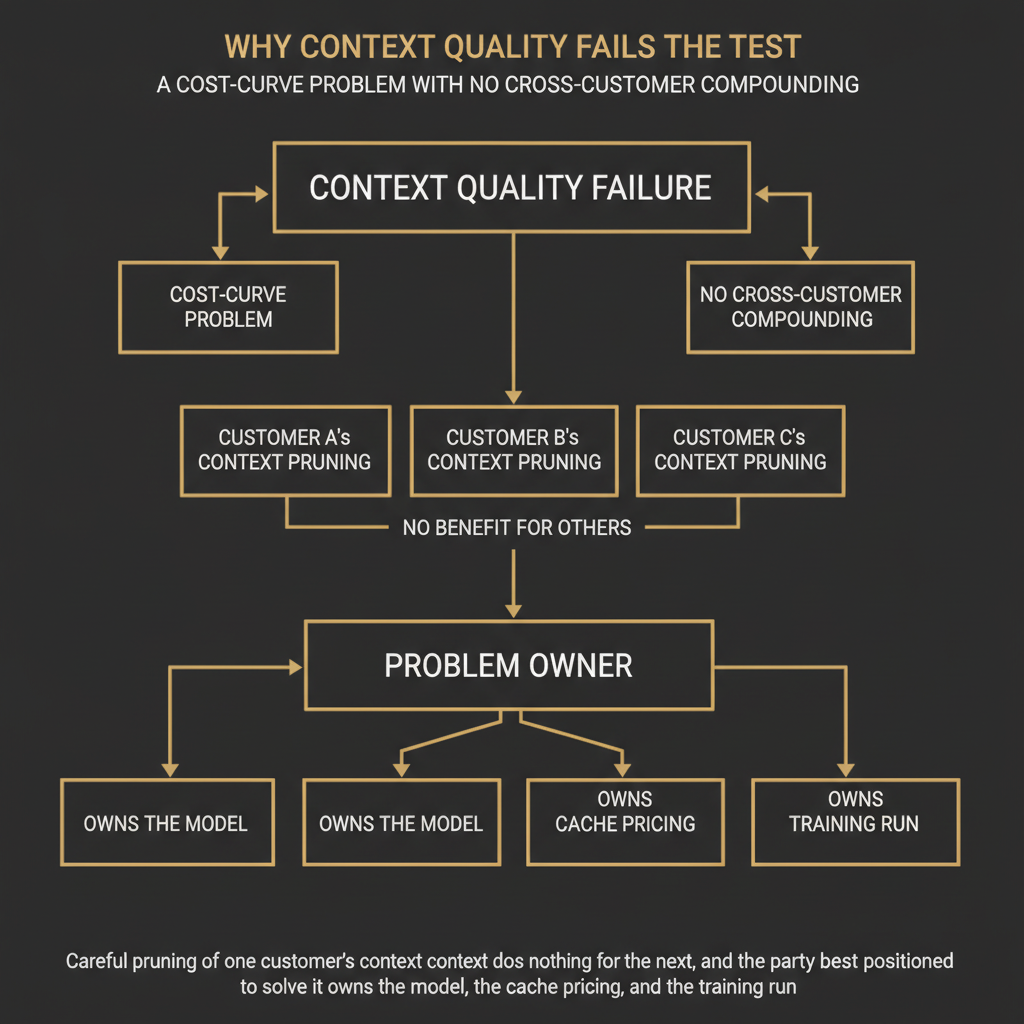
But here is where the moat argument breaks down: context quality is a cost-curve problem with no cross-customer compounding. The careful pruning you do for customer A does nothing for customer B. Every new customer starts the same retrieval and summarization problem from scratch. Your engineers get better at solving it, which is valuable, but that expertise lives in people and code patterns, not in an asset that accretes over time per user.
The party best positioned to win the context quality problem owns the model, the cache pricing, and the training run. Anthropic can bake better context management into Claude's architecture. OpenAI can make the memory layer a native API feature. Google can subsidize long-context costs through infrastructure advantages. When the model providers decide context management is their problem to solve, any lead you built in that layer compresses to zero. The Model Context Protocol is a good example of this dynamic: a standard for connecting agents to context sources, published by Anthropic, that any agent can now implement in an afternoon.
The maintenance liability nobody talks about
There is a version of the memory argument that is true but insufficient. Anyone who has run a serious instruction file or system prompt for more than a few months knows the drift problem. A line added in April to handle a specific edge case quietly degrades the agent's behavior in June when the context around it changes. The instruction file grows. Contradictions accumulate. The agent starts doing things that no single instruction tells it to do, but that emerge from the interaction of thirty instructions written at different times by different people.
Auto-generated memory rots the same way, just invisibly. When an agent writes its own memory entries, those entries are snapshots of a past state. The world changes, the user's situation changes, the product changes, and the memory entries do not update automatically. You end up with an agent that confidently applies stale context, which is often worse than no context at all because the failure mode is harder to detect.
This means memory is a liability to maintain, not an asset that accrues. The engineering work is not a one-time investment; it is an ongoing cost. A competitor who starts tomorrow does not inherit your memory debt. They start clean, implement the current best practices for context management, and close the gap faster than you might expect.
Here is a concrete example of how memory debt accumulates:
// Memory entry written in January
{
  "user_preference": "prefers email over SMS",
  "last_contact_channel": "email",
  "note": "user mentioned they check email in the morning"
}

// Six months later, the user has switched jobs,
// uses their phone constantly, and hasn't opened
// the email thread in four months.
// The agent still routes to email. The agent is wrong.
// Nobody flagged it because no error was thrown.
The memory was accurate when written. It is now actively harmful. Detecting and correcting this requires a maintenance process that most teams underinvest in, because the failures are slow and diffuse rather than loud and immediate.
Verification is not yours to own
The verification argument has the same structural problem, with an additional twist: the cheap oracle either exists in your domain or it does not, and you did not create that condition.
CI/CD pipelines have been verifying software agent outputs since before "AI agent" was a phrase anyone used. A function either returns the right value or it does not. A test suite either passes or it does not. The infrastructure for automated verification is mature, cheap, and widely understood. For domains where verification is easy (code generation, data extraction, form completion), you are not building a moat by doing it well. You are meeting the baseline expectation.
For domains where verification is hard (creative work, strategic advice, relationship management), the difficulty is not a feature of your product. It is a feature of the domain. You cannot make customer satisfaction objectively verifiable by building a clever scoring system, because the ground truth is inherently subjective. Your scoring proxy is not the moat; it is a workaround for the absence of one.
Verifiability tells you which market to enter. It says nothing about why you win it. A domain with cheap, reliable verification is attractive because you can measure and improve. But it is attractive to everyone, which means the verification infrastructure commoditizes fast. The economic moat concept requires that your advantage be durable and hard to replicate. Verification tooling, almost by definition, is built to be replicated.
The uptime analogy
The most useful reframe is this: both memory and verification are asymptotically mandatory as requirements and asymptotically worthless as differentiators. The closest existing analogy is uptime.
No serious SaaS company wins on uptime. Nobody's pitch deck says "we are the 99.99% uptime CRM." But every SaaS company loses without adequate uptime. Below a certain threshold, it is an active liability. Above that threshold, it is invisible. Customers do not pay more for five nines versus four nines; they just leave if you fall below four nines.
Memory and verification are heading to the same place. In 2024, an agent with good context management and reliable output verification is impressive. By 2026, it will be the floor. Customers will not pay a premium for it; they will simply not buy from agents that lack it. The race to build these capabilities is real and worth running. The mistake is treating the finish line as a competitive position rather than a table stake.
This has a practical implication for how you price. If you are charging a premium for "advanced memory" or "verified outputs," you are pricing on a feature that your competitors will match and that your model providers will eventually absorb. The premium will erode. Build the capability, but price on the outcome it enables, not on the capability itself.
What actually accumulates
If memory and verification are not the moat, the question becomes what is. The answer is whatever accumulates value across customers and across time in a way that a competitor starting tomorrow cannot purchase.
The diagnostic question to run against your own roadmap: what does a year of operating this accumulate that a new entrant cannot buy?
A few things pass that test. Domain-specific outcome data passes it, if you own the ground truth labels and they are not available elsewhere. Network effects pass it, if the product genuinely gets more useful as more agents or users join. Regulatory position passes it in domains where approvals are slow and expensive. Proprietary data pipelines pass it when the data source is exclusive or the collection process is legally or logistically hard to replicate.
Context quality and verification do not pass it. Both can be bought with engineering time. Both are being commoditized by model providers and open standards. Both are worth doing and neither is worth betting the company on.
The practical implication for how you treat context: think of it as a database with a named owner and a monthly cost per user, not as a proprietary asset. Budget it like infrastructure. Optimize it like a cost line. Do not confuse doing it well with having a durable advantage from it.
// Treat context as a cost center, not an asset
const contextCost = {
  userId: "user_123",
  monthlyTokensIn: 4_200_000,
  monthlyTokensOut: 840_000,
  // At $3/M input, $15/M output (mid-tier model estimate)
  estimatedMonthlyCost: (4.2 * 3) + (0.84 * 15), // $25.20/user/month
  owner: "product_team",
  reviewCycle: "monthly",
  // This is an operating expense, not a strategic asset
};

// The question is not "how good is our context?"
// The question is "what are we buying with this $25/user/month?"
When you frame context as a cost per user per month, the optimization question changes. You stop asking "how do we build the best memory system?" and start asking "what outcome does this context spend enable, and is that outcome worth the cost?" That is a harder question with a more useful answer.
Where to compete instead
The agent infrastructure layer is becoming a commodity market faster than most teams expect. The tools for giving agents memory, verifying their outputs, and connecting them to data sources are being standardized and open-sourced at a rapid pace. That is good news for anyone building on top of that infrastructure, because the cost of the foundation is falling.
The OneShot SDK is built on this premise: the actuation layer (voice, email, SMS, research, verification) should be cheap, reliable, and not the thing you differentiate on. OneShot charges per action via USDC through the x402 protocol, which means you pay for outcomes and the pricing is transparent. The point is not that OneShot's tools are magic; it is that they are good enough to build on without reinventing them, which frees your engineering capacity for the layer where accumulation is real.
The layer where accumulation is real is the targeting system: the benchmarks, the scoring standards, the definitions of what "good" looks like in your specific domain. Whoever establishes those definitions shapes what the market measures. What gets measured gets optimized for. What gets optimized for wins procurement decisions. This is not a new dynamic; it is how standards bodies and benchmark creators have always captured value in technology markets. The agent market is running the same play.
Soul.Markets is betting on this at the identity and capability layer: if agents need to discover, evaluate, and transact with each other, the platform that defines how agent capabilities are described and verified becomes the reference point that everyone else has to match. That is a different kind of moat than "we have better memory." It is a coordination moat, and it compounds across participants rather than per user.
The prediction
By Q4 2026, at least two major model providers will ship native memory APIs that make third-party context management offerings redundant for the majority of use cases. The teams that built context management as a differentiator will face a choice between rebuilding on top of the native APIs (which erases their lead) or maintaining a parallel system (which becomes a cost burden). Teams that treated context as infrastructure from the start will adapt faster.
The same consolidation will happen in verification tooling, probably six to twelve months later, as agent output testing frameworks mature into something closer to what Jest or pytest are for code.
The teams that win the 2026 to 2027 window will be the ones who used the current period to accumulate something that native model APIs cannot absorb: outcome data, domain standards, network density, or regulatory position. Memory and verification are the entry ticket. They are not the race.