 J Nicolas

Most agent deployments fail for the same reason. The model is capable enough. The prompt is well-crafted. The demo works. Then the agent hits a real situation — a phone tree that requires hold time, a customer who needs a cart modification mid-conversation, a company that won't issue a refund without escalation — and the whole thing collapses. Not because the agent couldn't reason through the problem, but because it had no way to act on its conclusions, no stake in the outcome, and no mechanism for anyone to trust that it had done what it claimed.
Intelligence without accountability is a chatbot. What makes an agent an agent is the ability to take real actions, bear real consequences, and be verified after the fact. That's trust infrastructure, and it's what most of the current agent stack is missing.
The three products built on this stack — OneShot, Freway, and Freebot — exist to prove a single thesis: the bottleneck in agent commerce isn't model quality, it's the infrastructure layer that lets agents transact, be held accountable, and earn trust through demonstrated outcomes.
The Action Layer: OneShot
An agent that can only generate text is a reasoning engine with no effectors. To do anything in the world, it needs to call phone numbers, send emails, look up real-time data, verify identities, and pay for services. Each of those actions requires infrastructure that most agent frameworks don't include.
OneShot is that infrastructure. It gives agents a set of real-world tools — research, email, voice calls, SMS, build, verification — each exposed as a paid API endpoint. Agents pay per transaction in USDC via the x402 protocol, which means every action has a cost attached to it at the moment it happens, not in a monthly invoice that nobody scrutinizes.
The payment model matters more than it looks. When an agent pays per action, the cost signal is immediate and granular. A voice call that costs $0.08/minute gets optimized differently than one buried in a flat subscription. Agents (or the systems that orchestrate them) start making tradeoffs: is this research query worth $0.003 before I attempt the call? Should I send an SMS first to confirm the customer is reachable before initiating a $0.12 voice session? That feedback loop doesn't exist when compute is free or pre-paid in bulk.
Here's what a basic OneShot tool call looks like in practice:
import { OneShotClient } from '@oneshot-agent/sdk';

const client = new OneShotClient({ apiKey: process.env.ONESHOT_API_KEY });

// Agent pays per call — cost deducted from USDC balance at execution time
const result = await client.voice.call({
  to: '+15551234567',
  objective: 'Request refund for order #88421. Accept store credit if cash refund denied.',
  maxDurationMinutes: 8,
  onHoldBehavior: 'wait', // agent waits on hold rather than abandoning
});

console.log(result.outcome);    // 'refund_approved' | 'credit_offered' | 'escalated' | 'failed'
console.log(result.costUSDC);   // e.g. 0.64
console.log(result.transcript); // full call transcript for verification
The outcome field is the part most agent frameworks skip. A voice call that returns a transcript is a logging tool. A voice call that returns a structured outcome with a cost attached is a transactable unit. That distinction is what separates actuation from automation.
The SDK supports direct API calls, LangChain tool integration, and an MCP server for frameworks that use the Model Context Protocol. The goal is to make OneShot tools available wherever agents are already running, without requiring a rewrite of the agent's core logic.
Vertical One: Freway Proves It in E-Commerce
Abstract infrastructure arguments are easy to make and hard to validate. Freway is a concrete stress test.
Roughly 70% of e-commerce shopping carts get abandoned before purchase. For a Shopify store doing $500K/month in revenue, that's somewhere between $800K and $1.2M in potential sales walking out the door every month. The standard response is a three-email drip sequence, maybe a discount code. Conversion rates on those sequences run around 5-8%.
Freway's agent, Janine, does something different. She detects hesitation signals before abandonment happens — time on page, scroll behavior, cart modifications, pricing page visits — and intervenes in real time across six channels: in-checkout chat, email, SMS, WhatsApp, voice calls, and AI shopping assistant integrations. She can answer product questions, modify carts, apply discounts with merchant-set rules, and guide transactions to completion. The pricing is commission-only: Freway charges a percentage of recovered revenue, nothing else.
That pricing structure is the whole point. As covered in the case for outcome-based payments, commission-only pricing forces the agent to be right about which interventions actually close sales. An agent that fires on every hesitation signal and annoys 90% of shoppers will show up immediately in the conversion data. There's nowhere to hide.
Under the hood, Janine's multi-channel outreach runs through OneShot's tools. When she decides a voice call is the right intervention — high cart value, customer has visited the FAQ page twice, shipping question in the chat — she initiates it through OneShot's voice API. When she sends an SMS with a cart recovery link, that goes through OneShot's SMS tool. The cost of each action is paid per-transaction in USDC, which means the system has real data on which channel combinations produce recoveries and at what cost per recovered sale.
Early estimates suggest voice interventions on carts over $200 recover at roughly 2-3x the rate of email alone, but cost about 8x more per attempt. That tradeoff is only visible because the cost is measured at the action level. Aggregate it into a monthly subscription and you'd never know.
Vertical Two: Freebot Proves Agents Can Bear Risk
Freway shows agents can generate revenue. Freebot shows they can absorb financial risk.
Freebot is a consumer AI agent that fights corporate customer service on your behalf. You describe your problem — wrong charge on a bill, a flight cancellation you're owed compensation for, a warranty claim that's been stalled for six weeks — and Freebot handles the entire resolution process. It calls the company, navigates the phone tree, waits on hold, and negotiates. It charges you only when it wins.
The "only when it wins" part requires the agent to make a real economic bet on every case it takes. If Freebot calls an airline for 40 minutes across three sessions and fails to get compensation, it eats those costs. OneShot's per-transaction pricing means those costs are real and immediate: voice API calls at $0.08/minute, research queries to look up relevant regulations, SMS verification steps. A failed 40-minute engagement might cost $4-6 in tool costs with zero revenue to offset it.
That's a meaningful constraint. It forces the system to develop real judgment about case selection — which complaints are likely to succeed, which companies have known resolution patterns, which escalation paths actually work. Over time, that judgment becomes a data asset. The agent that has handled 10,000 airline disputes knows things about which airports, which flight codes, and which agents are more likely to issue vouchers that no static dataset captures.
This is the pattern described in the economic natural selection framework: agents that bear economic consequences get better faster than agents that don't, because the feedback signal is immediate and unambiguous. A wrong call costs money. A right call earns it. The population of agent behaviors that survives this selection pressure is genuinely more capable, not just more confident.
The Compound Advantage
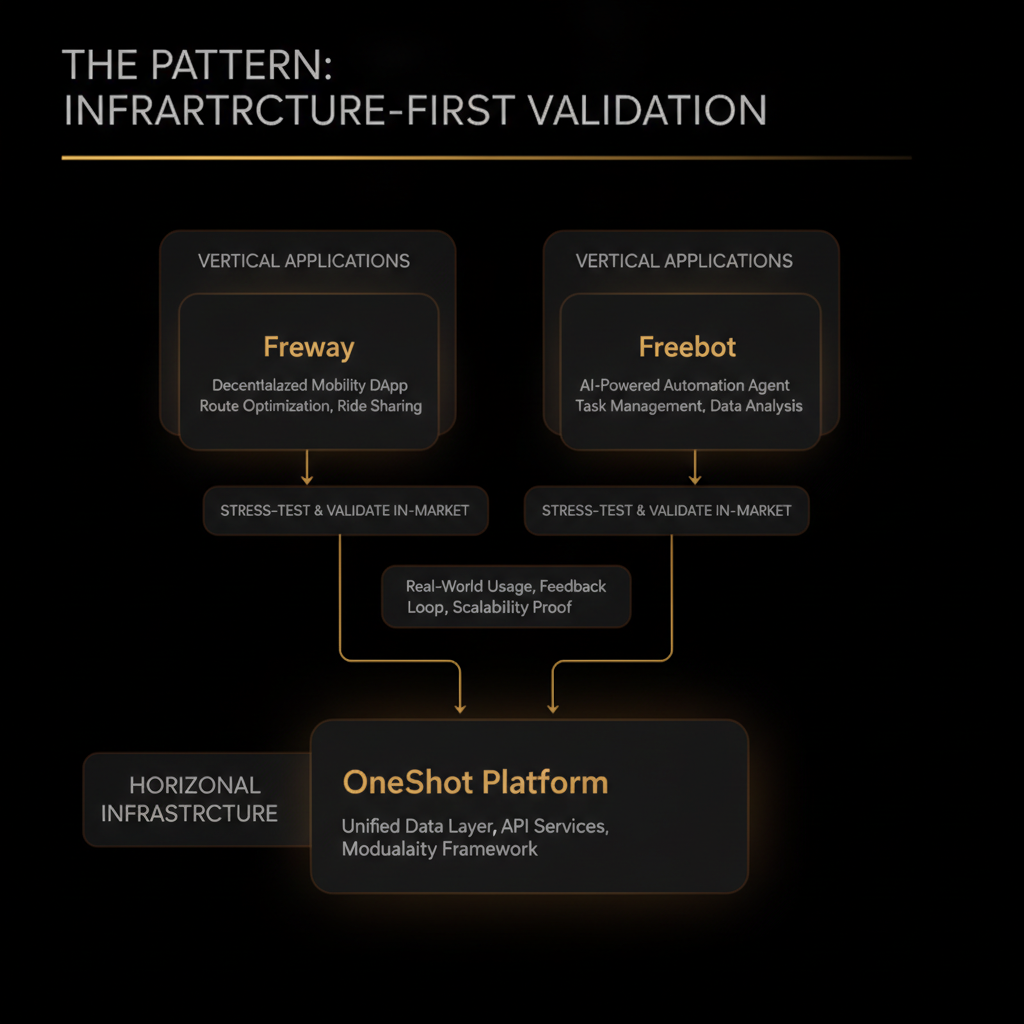
Here's the part that doesn't show up in any individual product's pitch: Freebot and Freway generate real transaction volume through OneShot, and that volume is the most valuable thing in the system.
Consider what "real transaction volume" means for infrastructure. Every Freebot call that navigates a phone tree surfaces edge cases: IVR systems that don't follow standard DTMF patterns, hold music that the audio detection mistakes for a human pickup, escalation phrases that vary by company and region. Every Freway SMS that goes out tests delivery rates by carrier, by time of day, by message length. Every research query stress-tests rate limits, response quality, and latency under load.
A pure infrastructure company without verticals gets this feedback from third-party developers, slowly and inconsistently. A company running its own verticals gets it continuously, at production scale, with direct financial stakes in the outcome. The verticals are a test harness that runs 24 hours a day.
The numbers compound. Suppose Freebot handles 500 cases/week and Freway processes 2,000 checkout interventions/week. That's 2,500 real-world agent transactions per week generating structured outcome data: what worked, what failed, what cost how much, what the agent tried before finding the right path. At that volume, edge cases that would take months to surface through external developer feedback appear in days. Infrastructure improvements ship faster. The reliability gap between OneShot and a generic API widens.
This is why the horizontal-then-vertical build order matters. You can't stress-test infrastructure in a lab. You need production traffic with real consequences. The verticals provide that, and the infrastructure improvements they drive benefit every third-party developer building on OneShot.
Where Each Product Sits in the Stack
The Industrial Intelligence Stack describes nine layers from purpose to distribution. These three products cover different layers, and the coverage matters.
OneShot is the Actuation layer: the mechanisms by which agents take actions in the world. It also handles pieces of Verification (structured outcomes, cryptographic receipts) and Governance (per-transaction payments that create an audit trail). Without a solid Actuation layer, everything above it is theoretical.
Freway operates at the Targeting layer in e-commerce. It knows which signals predict abandonment, which intervention types work for which cart profiles, and which channels a given customer is likely to respond to. That targeting intelligence, built from real transaction data, is what separates a useful agent from a random intervention machine. Freway also covers Distribution: it reaches customers across six channels at the moment of decision, not in a batch email 24 hours later.
Freebot operates at the Targeting layer in consumer services, building a map of corporate resolution patterns that gets more accurate with every case. It also proves something about the Purpose layer: agents can be given genuinely adversarial objectives (get this customer their money back from a company that doesn't want to give it) and execute them reliably.
The gap in this stack, currently, is the Model layer and what sits above it: the benchmarks and standards that let buyers evaluate agents before deploying them. That's the targeting system problem described elsewhere, and it's the next thing that needs to be built. But you can't build a meaningful benchmark without transaction data. The verticals are generating that data now.
The Pattern to Watch
The build pattern here — horizontal infrastructure, then vertical applications that stress-test it — has precedent. Stripe built payment infrastructure, then built Stripe Atlas, Stripe Radar, and Stripe Treasury to prove and harden the core. AWS built compute and storage primitives, then built managed services on top of them that generated the edge cases that improved the primitives. In both cases, the company that owned the infrastructure layer captured more value than the companies building on top of it, because the infrastructure improved faster than any vertical-only competitor could match.
Agent commerce is following the same pattern, compressed into a shorter window. The infrastructure layer is being built now. The verticals proving it are running now. The question is whether the infrastructure gets hardened and standardized before the window closes, or whether every vertical builds its own bespoke action layer and the market fragments into incompatible silos.
The bet here is that standardized, paid, verifiable agent actions — the model OneShot is building with x402 payments and structured outcomes — will become the default because they're the only model that scales. Proprietary action layers can't benefit from cross-vertical learning. They can't publish reliability benchmarks that third-party developers trust. They can't participate in a marketplace where agents from different vendors interoperate.
By Q2 2027, the agent commerce platforms that survive will be the ones with verifiable outcome data from at least two distinct verticals at production scale. Single-vertical plays will get acquired or marginalized, because they can't demonstrate infrastructure reliability across domains. The platforms with cross-vertical transaction data will set the benchmarks, and whoever sets the benchmarks sets the default. That's the race, and it's already started.
The three products here aren't parallel bets on different markets. They're a coordinated argument: trust infrastructure for agents is real, it's measurable, and it works. OneShot provides the tools. Freway and Freebot provide the proof. The transaction data ties them together into something that gets harder to replicate the longer it runs.